Deep Inguinal Ring Medial to the Inferior Epigastric Vessels: A Novel Finding
Article Sidebar
Main Article Content
Abstract
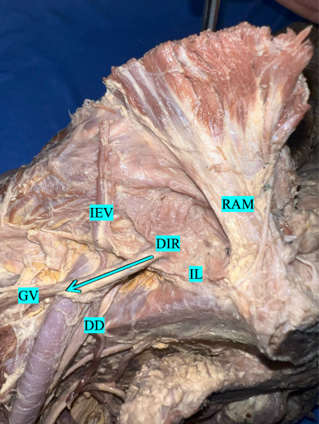
The deep inguinal ring is a critical anatomical landmark in groin hernia repair and is classically described as an opening in the transversalis fascia located lateral to the inferior epigastric vessels. Variations in its position have been reported; however, a relationship in which the ring lies medial to the inferior epigastric vessels has not previously been described. We report a rare anatomical finding observed during routine cadaveric dissection of a male specimen. The specimen was sectioned transversely at the level of the iliac crest and sagittally through the pubic symphysis and linea alba, preserving the lower left anterior abdominal wall. Upon dissection of the inguinal region, the deep inguinal ring was identified medial to the inferior epigastric vessels and within the boundaries of Hesselbach’s triangle. The spermatic cord structures traversed this opening and followed the expected course through the inguinal canal. Macroscopic examination demonstrated preserved continuity of the surrounding transversalis fascia, and no hernia sac or herniated tissue was identified. Because no clinical or demographic information was available, the origin of this configuration could not be determined and a previously acquired pathological process cannot be completely excluded. Recognition of such an anatomical variation may be important during radiological evaluation and open, laparoscopic, or robotic groin surgery, where the inferior epigastric vessels are routinely used as landmarks for hernia classification and operative planning. To our knowledge, this finding has not been previously documented in the literature.
Article Details

This work is licensed under a Creative Commons Attribution 4.0 International License.
Authors retain the copyright of their articles and grant the journal the right of first publication under the Creative Commons Attribution (CC BY) license, which allows others to share and adapt the work with proper attribution.
References
Fitzgibbons RJ Jr, Forse RA. Groin hernias in adults. N Engl J Med. 2015;372(8):756-63. doi: 10.1056/NEJMcp1404068.
Conaghan P, Hassanally D, Griffin M, Ingham Clark C. Where exactly is the deep inguinal ring in patients with inguinal hernias? Surg Radiol Anat. 2004;26(3):198-201. doi: 10.1007/s00276-003-0203-1.
Sanjay P, Reid TD, Bowrey DJ, Woodward A. Defining the position of deep inguinal ring in patients with indirect inguinal hernias. Surg Radiol Anat. 2006;28(2):121-4. doi: 10.1007/s00276-006-0105-0.
Rosenberg J, Baig S, Chen DC, Derikx J. Groin hernia. Nat Rev Dis Primers. 2025;11(1):47. doi: 10.1038/s41572-025-00631-4.
Hope WW, Marietta M, Pfeifer C. Minimally invasive inguinal hernia repair. In: StatPearls [Internet]. Treasure Island (FL): StatPearls Publishing; 2026 Jan–. Updated 2026 May 7 [cited 2026 Jun 16].
Cesare Stabilini, Nadine van Veenendaal, Eske Kvanner Aasvang, Agresta F, Aufenacker T, Frederik Berrevoet, et al. Update of the international HerniaSurge guidelines for groin hernia management. BJS open. 2023 Sep 5;7(5).