Spinal Cord Infarction Due to Fibrocartilaginous Embolism: A Case Report and Review of Diagnostic Clues
Article Sidebar
Main Article Content
Abstract
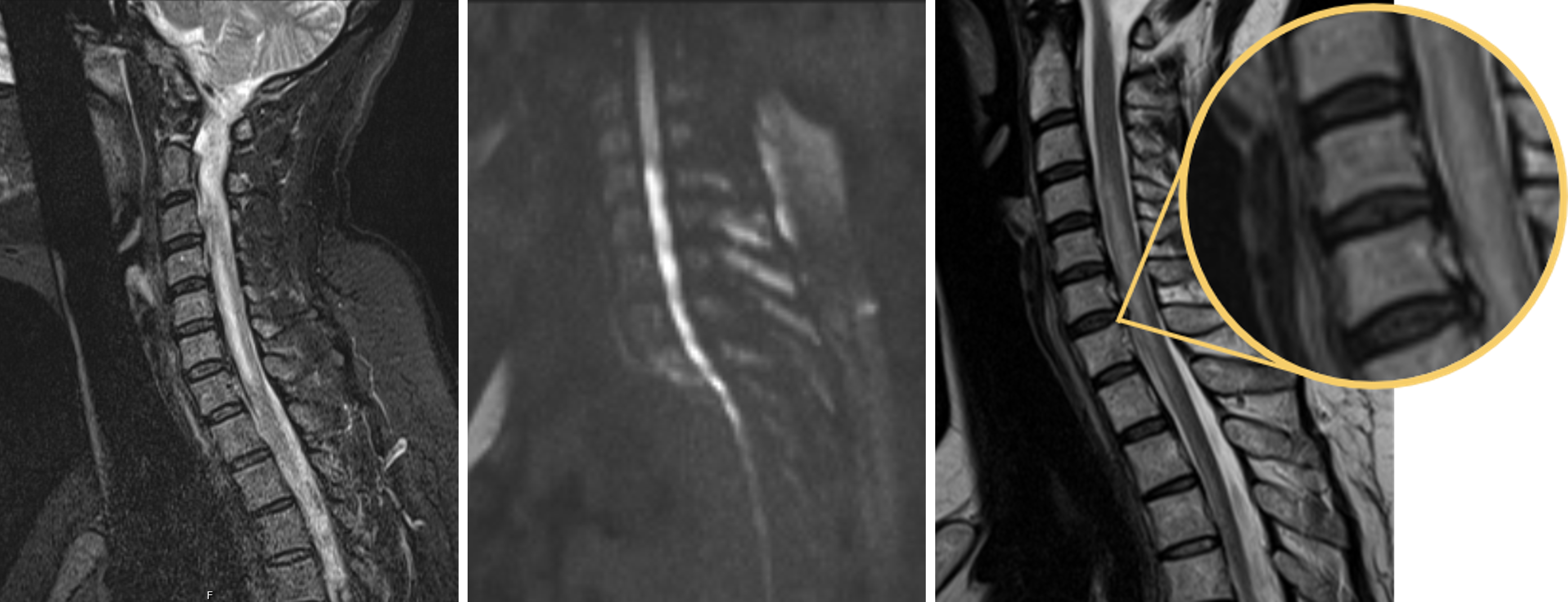
Spinal cord infarction is a rare entity, accounting for 1-2% of acute ischemic disorders of the central nervous system. Fibrocartilaginous embolism (FCE), characterized by migration of nucleus pulposus material into the spinal cord vasculature, constitutes an uncommon and underrecognized etiology. We describe the case of a 49-year-old woman, previously independent, who developed acute myelopathy with flaccid tetraparesis, C5 sensory level, and dysautonomia. Magnetic resonance imaging (MRI) revealed an extensive intramedullary lesion from C4 to T1 with diffusion restriction and disc extrusion at C6-C7 with annular fissure. After exclusion of other etiologies, the diagnosis of spinal cord infarction secondary to FCE was established. The patient started antiplatelet therapy, statin, and intensive rehabilitation, with neurological stability but without significant early functional recovery. This case illustrates the importance of considering this entity in adults with low vascular risk and disc degeneration, highlighting the crucial role of diffusion-weighted MRI in diagnosis, thereby ensuring appropriate management with impact on functional outcomes.
Article Details

This work is licensed under a Creative Commons Attribution 4.0 International License.
Authors retain the copyright of their articles and grant the journal the right of first publication under the Creative Commons Attribution (CC BY) license, which allows others to share and adapt the work with proper attribution.
References
Zalewski NL, Rabinstein AA, Krecke KN, Brown RD Jr, Wijdicks EFM, Weinshenker BG, Kaufmann TJ, Morris JM, Aksamit AJ, Bartleson JD, Lanzino G, Flanagan EP. Characteristics of spontaneous spinal cord infarction and proposed diagnostic criteria. JAMA Neurol. 2019 Jan 1;76(1):56-63. doi: 10.1001/jamaneurol.2018.2734.
Stenimahitis V, Fletcher-Sandersjöö A, El-Hajj VG, Tatter C, Edström E, Elmi-Terander A. Long-term outcomes after peripro-cedural and spontaneous spinal cord infarctions: a population-based cohort study. Neurology. 2023 Jul 11;101(2):e114-e124. doi: 10.1212/WNL.0000000000207377.
Romi F, Naess H. Spinal cord infarction in clinical neurology: a review of characteristics and long-term prognosis in comparison to cerebral infarction. Eur Neurol. 2016;76(3-4):95-98. doi: 10.1159/000446700.
Williams LS, Bruno A, Biller J. Spinal cord infarction. Top Stroke Rehabil. 1996;3(1):41-53. doi: 10.1080/10749357.1996.11754104.
Bansal S, Brown W, Dayal A, Carpenter JL. Posterior spinal cord infarction due to fibrocartilaginous embolization in a 16-year-old athlete. Pediatrics. 2014 Jul;134(1):e289-92. doi: 10.1542/peds.2013-2468.
Lišková Z, Lehotská V, Liška M, Mikula P. Fibrocartilaginous embolization - a rare cause of spinal cord infarction: case report. J Radiol Case Rep. 2018 Dec 31;12(12):1-9. doi: 10.3941/jrcr.v12i12.3411.
AbdelRazek MA, Mowla A, Farooq S, Silvestri N, Sawyer R, Wolfe G. Fibrocartilaginous embolism: a comprehensive review of an under-studied cause of spinal cord infarction and proposed diagnostic criteria. J Spinal Cord Med. 2016;39(2):146-54. doi: 10.1080/10790268.2015.1116726.
Ke W, Chen C, Li S, Wang Y, Chen Y, Guo Y, Zheng W. Clinically suspected fibrocartilaginous embolism: a case report and literature review. Int J Neurosci. 2022 Apr;132(4):378-383. doi: 10.1080/00207454.2020.1817008.
Nagaratnam SA, Lee RLK, Sturm J. Fibrocartilaginous embolism: an under-recognised cause of young spinal stroke. Pract Neurol. 2022;22(4):324-327. doi: 10.1136/practneurol-2021-003175.
Zedde M, De Falco A, Zanferrari C, Guarino M, Pezzella FR, Haggiag S, Cossu G, Quatrale R, Micieli G, Del Sette M, Pascarella R. Spinal cord infarction: clinical and neuroradiological clues of a rare stroke subtype. J Clin Med. 2025 Feb 15;14(4):1293. doi: 10.3390/jcm14041293.