Multimodal Diagnosis of Cervical Spinal Cord Compression in a Dog: The Role of Accessible Imaging in Complex Decision-Making
Article Sidebar
Main Article Content
Abstract
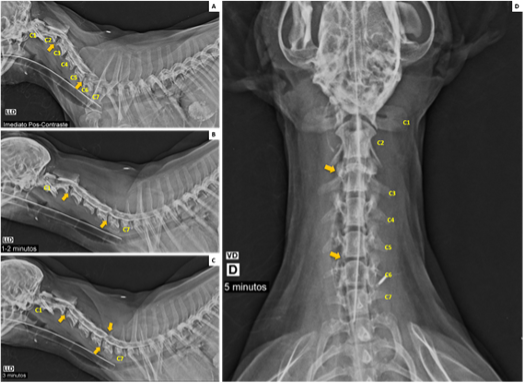
Intervertebral disc disease (IVDD) is a leading cause of spinal cord compression in dogs, frequently affecting the cervical region. This case report describes the diagnostic approach and imaging findings in a geriatric Shih-Tzu presenting cervical pain and progressive neurological signs, highlighting the importance of accessible diagnostic tools in clinical routine. Initial clinical evaluation and plain radiography suggested cervical disc involvement, revealing a narrowed intervertebral space at a single segment. Due to the persistence and worsening of clinical signs, myelography was performed in conjunction with cerebrospinal fluid (CSF) analysis, allowing for the exclusion of inflammatory or infectious central nervous system disorders. Myelography revealed two cervical regions with extradural compression. Subsequently, computed tomography (CT) demonstrated three affected cervical intervertebral spaces, including disc extrusion and protrusions with varying degrees of spinal cord compression. Although advanced imaging modalities offer greater diagnostic accuracy, this report demonstrates that contrast radiography and CSF analysis, when correctly indicated and interpreted, remain relevant and viable diagnostic tools in veterinary practice. Despite the confirmation of multifocal cervical IVDD, the owner opted against surgical treatment.
Article Details

This work is licensed under a Creative Commons Attribution 4.0 International License.
Authors retain the copyright of their articles and grant the journal the right of first publication under the Creative Commons Attribution (CC BY) license, which allows others to share and adapt the work with proper attribution.
References
König HE, Liebich HG. Veterinary anatomy of domestic mammals: textbook and colour atlas. 7th ed. Stuttgart: Thieme; 2021.
Brisson BA. Intervertebral disc disease in dogs. Vet Clin North Am Small Anim Pract. 2010 Jan;40(1):829-858. doi:10.1016/j.cvsm.2010.06.001.
Jeffery ND, Levine JM, Olby NJ, Stein VM. Intervertebral disk degeneration in dogs: consequences, diagnosis, treatment, and future directions. J Vet Intern Med. 2013 Nov-Dec;27(6):1318-1333. doi:10.1111/jvim.12183.
Thrall DE. Textbook of veterinary diagnostic radiology. 7th ed. St. Louis: Elsevier; 2022.
Beltran E, Dennis R, Doyle V, de Stefani A, Holloway L, De Risio L. Clinical and magnetic resonance imaging features of canine compressive cervical myelopathy with suspected hydrated nucleus pulposus extrusion. J Small Anim Pract. 2012;53(2):101-107. doi:10.1111/j.1748-5827.2011.01166.x.
Casado D, Fernandes R, Lourinho F, Gonçalves R, Clark R, Violini F, Carrera I. Magnetic resonance imaging features of ca-nine intradural/extramedullary intervertebral disc extrusion in seven cases. Front Vet Sci. 2022 Sep 14;9:1003042. doi:10.3389/fvets.2022.1003042.
Braund KG. Intervertebral disk disease. In: Bojrab MJ, Smeak DD, Bloomberg MS, editors. Disease mechanisms in small animal surgery. 2nd ed. Philadelphia: Lea & Febiger; 1993. p. 960-970.
Janssens LAA. The treatment of canine cervical disc disease by means of acupuncture: a review of thirty-two cases. J Small Anim Pract. 1985 Aug;26(4):203-212. doi:10.1111/j.1748-5827.1985.tb02102.x.
Toombs JP, Bauer MS. Intervertebral disc disease. In: Slatter D, editor. Textbook of small animal surgery. 2nd ed. Philadel-phia: Saunders; 1992. p. 1063-1080.
Lamb CR, Nicholls A, Targett MP, Mannion P. Accuracy of survey radiographic diagnosis of intervertebral disc protrusion in dogs. Vet Radiol Ultrasound. 2002 Mar-Apr;43(2):222-228. doi:10.1111/j.1740-8261.2002.tb00994.x.
Olby NJ, Moore SA, Brisson B, Fenn J, Flegel T, Kortz G, Lewis MJ, Tipold A. ACVIM consensus statement on diagnosis and management of acute canine thoracolumbar intervertebral disc extrusion. J Vet Intern Med. 2022;36(5):1570-1596. doi:10.1111/jvim.16480.
Robertson ID, Thrall DE. Imaging diagnosis—spinal diseases. In: Thrall DE, editor. Textbook of veterinary diagnostic radi-ology. 6th ed. St. Louis: Elsevier; 2011. p. 208-229.
Bos AS, Brisson BA, Nykamp SG, Poma R, Foster RA. Accuracy, intermethod agreement, and inter-reviewer agreement for use of magnetic resonance imaging and myelography in small-breed dogs with naturally occurring first-time intervertebral disk extrusion. J Am Vet Med Assoc. 2012 Apr 15;240(8):969-977. doi:10.2460/javma.240.8.969.
Chrisman CL. Cerebrospinal fluid analysis. Vet Clin North Am Small Anim Pract. 1992 Jul;22(4):781-810. doi:10.1016/S0195-5616(92)50077-8.
Levine GJ, Cook JR, Kerwin SC, Mankin JM, Griffin JF, Fosgate GT, Levine JM. Relationships between cerebrospinal fluid characteristics, injury severity, and functional outcome in dogs with and without intervertebral disk herniation. Vet Clin Pathol. 2014 Jun;43(3):437-446. doi:10.1111/vcp.12165.
Di Terlizzi R, Platt SR. The function, composition and analysis of cerebrospinal fluid in companion animals: part II—analysis. Vet J. 2009;180(1):15-32. doi:10.1016/j.tvjl.2007.11.024.
Israel SK, Levine JM, Kerwin SC, Levine GJ, Fosgate GT. The relative sensitivity of computed tomography and myelography for identification of thoracolumbar intervertebral disk herniations in dogs. Vet Radiol Ultrasound. 2009 May-Jun;50(3):247-252. doi:10.1111/j.1740-8261.2009.01528.x.
Newcomb B, Arble J, Rochat M, Pechman R, Payton M. Comparison of computed tomography and myelography to a refer-ence standard of computed tomographic myelography for evaluation of dogs with intervertebral disc disease. Vet Surg. 2012 Apr;41(2):207-214. doi:10.1111/j.1532-950X.2011.00911.x.